
PFAS: What’s Changing, What’s Emerging, and Why It Matters

PFAS reporting

BRIEF: EPA’s TSCA Section 8(a)(7) PFAS reporting rule now requires manufacturers and importers to begin reporting on April 13, 2026. The rule demands detailed, “reasonably ascertainable” data across uses, volumes, byproducts, exposure, and disposal. At the same time, attention is expanding to persistent degradation products like TFA. Together, these forces are pushing PFAS beyond compliance into transparency and risk management. Companies that organize product data now will be better positioned as deadlines—and scrutiny—approach.

PFAS oversight has become less linear and more unsettled. EPA’s TSCA Section 8(a)(7) reporting rule was designed to bring structure to how PFAS have been manufactured and used, but recent extensions and clarifications reflect how complex that task has proven to be in practice. For most manufacturers and importers, reporting begins April 13, 2026.

In November 2025, the EPA proposed changes to the scope of TSCA 8(a)(7) PFAS reporting regulations. Read the Federal Register Notice.  

The scope of what must be reported is broad. Companies are expected to submit information that is known to or reasonably ascertainable. This includes chemical identity, uses, production volumes, byproducts, worker exposure, disposal practices, and any available health or environmental data. Reporting must be completed electronically through EPA’s CDX system, which places additional emphasis on data readiness and internal coordination well before the submission window opens.

At the same time, the conversation is moving beyond familiar PFAS compounds. Trifluoroacetic acid (TFA) has appeared with increasing frequency in global water studies. It is not broadly regulated in the United States, but its prevalence has prompted questions about long-term environmental behavior and whether existing oversight frameworks are keeping pace with emerging science.

For manufacturers, this moment is less about compliance checklists and more about preparedness. Customers ask different questions than they did even a few years ago. They want to know what materials are present, how those materials persist, and what happens downstream. PFAS has shifted from a narrow regulatory topic to a broader transparency issue, touching procurement, product stewardship, and executive risk discussions—often well before regulators knock.

For customers paying closer attention to PFAS and emerging contaminants, Brainerd Chemical’s product portfolio reflects a practical advantage grounded in formulation discipline and documentation. The company emphasizes chemistries that meet performance needs without introducing unnecessary persistence concerns, supported by clear product data and traceability. In applications such as water treatment, sanitation, and industrial processing, this approach gives customers better visibility into what they are using and why—an increasingly important factor as reporting deadlines approach and expectations continue to sharpen.

Why this has become a board-level issue

The April 2026 reporting start date may seem distant, but the data required spans more than a decade of activity. Customers, auditors, and regulators are already pressing for clarity around inputs, intermediates, and byproducts—often earlier in the sourcing process.

PFAS compliance is no longer viewed solely as a regulatory requirement. It has become a measure of credibility—tied to how clearly a company understands its products, how well it documents them, and how confidently it can explain both today and five years from now.

Looking ahead

As the April 2026 reporting deadline approaches, the difference between manageable compliance and a costly scramble will come down to preparation. For many customers, Brainerd Chemical plays a quiet but important role in that process by reducing uncertainty early—through clear product documentation, consistent data, and chemistries designed with stewardship in mind. When suppliers can answer questions clearly, customers spend less time chasing historical data, reconciling gaps, or responding under pressure. That clarity doesn’t just support compliance; it saves time, limits disruption, and helps prevent the kind of last-minute reporting issues that turn regulatory obligations into operational crises.


Why Formaldehyde Matters in Poultry Feed Safety

Poultry feed production facility using formaldehyde-based food intervention controls

Feed safety is where food safety truly begins. Long before processing or packaging, controlling pathogens at the feed level plays a major role in protecting flock health and reducing downstream risk.

That’s where industrial formaldehyde comes in. Because of its powerfully effective characteristics, formaldehyde demands disciplined handling, accurate dosing, and dependable supply. Poultry operations don’t have room for variability or interruptions, especially when feed safety programs are tightly integrated into overall production schedules.

Effective intervention isn’t about reacting later. It’s about controlling risk early, consistently, and responsibly. That starts with the right formaldehyde supply partner. Brainerd Chemical is an ACD Responsible Distribution–verified supplier, a designation that reflects audited standards for safety, environmental responsibility, and supply-chain stewardship. In food intervention applications, that level of discipline helps reduce risk where it matters most. And, the Brainerd Chemical team supports poultry producers with consistent industrial formaldehyde supply backed by a strong focus on safe handling, packaging integrity, and logistics reliability. Customers benefit from a partner that understands both the chemistry and the operational realities of poultry feed manufacturing.

About Brainerd Chemical Company

Brainerd Chemical Company is a leading U.S. manufacturer and distributor of specialty and commodity chemicals. Our mission is simple yet powerful: to safely supply the solutions our customers need, the expertise they want, and the reliability they depend on—every single day.

Media Inquiries

Brainerd Chemical Company

📞 +1 (918) 622-1214

🌐 www.BrainerdChemical.com

Why Redundant Hydrogen Peroxide Supply Matters

Loading industrial hydrogen peroxide

Brief: Facilities that rely on a single hydrogen peroxide supply source face greater operational risk when supply tightens. With no new producers coming online and existing plants operating on aging infrastructure, even routine maintenance can disrupt production. This article explores why redundant sourcing, disciplined storage and handling, and reliable distribution partners are essential to maintaining operational continuity.

“In a tight market, reliability comes from doing the fundamentals right every day,” says Derk Pinkerton, Corporate Sales Supervisor. “Redundant supply only works if the chemistry, the equipment, and the people handling it are aligned. Stewardship is what keeps all three working together when conditions get challenging.”

Hydrogen peroxide is one of those chemicals most operations don’t think about until it becomes a problem. It supports essential processes across water treatment, manufacturing, energy production, pulp and paper, and environmental remediation. It works cleanly, reacts predictably, and often sits quietly in the background doing exactly what it’s supposed to do.

What has changed is the market that supports it. With no meaningful new domestic producers entering the market, and much of the existing capacity depends on aging production assets. Many facilities are operating near their practical limits, which leaves little room to absorb disruptions. When a producer goes down for planned maintenance or unexpected equipment issues, availability can tighten quickly. For operations that rely on hydrogen peroxide as a core process input, this isn’t just a purchasing concern. It’s an operational risk. Unlike some bulk chemicals, hydrogen peroxide cannot be stockpiled indefinitely. It degrades over time, and storage conditions must be carefully controlled. That reality limits how much buffer inventory a facility can realistically carry and places more importance on the reliability of the supply chain itself.

Facilities that depend on a single producer or distribution path are often the first to feel pressure when supply tightens. Delayed deliveries, spot-market pricing, and last-minute substitutions can disrupt production schedules and create downstream compliance challenges. In some cases, the impact isn’t measured in days, but in hours.

Redundant supply planning helps reduce that exposure. Working with qualified distributors who maintain multiple sourcing options, flexible packaging formats, and established logistics networks allows operations to stay ahead of disruptions rather than react to them.

Storage and handling practices also play a role in supply continuity. Contamination, incompatible materials, or poor temperature control can accelerate decomposition and take equipment or inventory out of service. In a constrained market, losing usable product to preventable issues adds unnecessary strain.

Transportation discipline matters just as much. Properly trained drivers, dedicated equipment, and thoughtful delivery scheduling help minimize on-site dwell time and reduce risk during transfer. Reliable distribution is not separate from process safety. It is part of it.

As hydrogen peroxide demand continues across critical industries, the question is no longer whether supply disruptions will happen, but how prepared facilities are when they do. Redundant sourcing, responsible distribution, and proactive planning help ensure hydrogen peroxide remains a dependable tool rather than a vulnerability.

For many facilities, redundant supply planning starts with choosing the right distribution partner. Brainerd Chemical Company supports industrial hydrogen peroxide customers through a diversified supply network designed to reduce single-point failures. Brainerd Chemical provides hydrogen peroxide in concentrations ranging from 1-50% that includes access to multiple qualified production sources, dedicated peroxide-compatible equipment, and flexible packaging options ranging from drums and totes to bulk deliveries.

Just as important is Brainerd’s stewardship approach. Storage compatibility, contamination prevention, transportation discipline, and customer training are treated as part of supply reliability, not separate safety checkboxes. By aligning operational knowledge with a focus on responsible distribution, Brainerd helps customers maintain continuity, protect on-site systems, and avoid the downstream impacts that occur when peroxide supply becomes constrained at the wrong moment.

Why the Next Decade Belongs to Agile Chemical Producers

Brief: Chemical manufacturing is facing a rare convergence of pressure and possibility. Persistent supply chain volatility, regulatory delays, workforce gaps, and rising capital costs continue to strain reliability. Yet these same forces are increasing the value of operational discipline, technical partnership, and responsive problem-solving. Customers across nearly every sector now prioritize certainty, stewardship, and specialty capability over low-cost sourcing. This shift gives agile chemical producers—especially mid-sized U.S. manufacturers with flexible assets and strong safety culture—a unique competitive advantage in the decade ahead.

The State of Chemical Manufacturing: What’s Holding Us Back—and What Has Me More Optimistic Than Ever

The last several years have rewritten the operating environment for chemical manufacturers. Supply chain instability, regulatory uncertainty, talent shortages, and capital pressures have forced companies to rethink how they plan, produce, and deliver critical chemicals. Yet despite these headwinds, the fundamentals of the North American market have never been stronger.

Across nearly every sector – energy, water treatment, food processing, electronics, and industrial manufacturing – customers are prioritizing reliability over low-cost sourcing. For mid-sized U.S. producers, that shift represents a generational opportunity.

Operational Pressure Is Reshaping the Industry

Operational constraints are real and unavoidable—volatile logistics, extended permitting timelines, retiring technical talent, and rising equipment costs all shape how chemical companies plan and produce. But these pressures are also redrawing the competitive map. In this environment, agile chemical producers—particularly mid-sized manufacturers—are increasingly positioned to outperform larger, slower-moving competitors. Their advantage is structural: they can reconfigure production faster, make decisions without layers of bureaucracy, and respond to customer disruptions in real time. This agility allows them to maintain reliability even when the broader system is strained, reinforcing their value as dependable partners in an unpredictable market. As pressures intensify, it’s the companies capable of combining discipline, speed, and safety that will define the new standard for operational excellence.

Specialty and Stewardship-Driven Growth Outpacing Commodities

While commodity markets remain cyclical, specialty chemistry is accelerating:

  • Oil & gas biocides (particularly PAA)
  • Water treatment chemistries
  • Food-grade and high-purity blends
  • Electronics-support chemicals
  • Custom formulations and toll manufacturing

Growth in these sectors favors manufacturers with flexible assets, strong engineering rigor, and a culture built around quality and compliance. Customers increasingly want more than product—they want process knowledge, documentation, technical support, and transparent guidance on storage, handling, and safety.

Safety, Compliance, and Culture as Competitive Advantages

In a tightening regulatory landscape, companies with mature safety systems and strong environmental stewardship are separating themselves from the field. Compliance has become a sales advantage. Reliability has become brand equity. And transparency—real transparency—is now a differentiator.

This evolution aligns with broader reshoring trends. Domestic producers capable of delivering consistent quality, providing technical partnerships, and maintaining rigorous safety programs are steadily capturing market share from international suppliers.

Technology Is Providing Leverage Where It Matters Most

Automation, digital inventory tracking, AI-assisted maintenance, and upgraded QC analytics are improving throughput, reducing unplanned downtime, and elevating the precision of specialty production. These tools enable mid-sized manufacturers to operate with large-scale discipline while retaining agility.

Technology is not replacing chemical expertise — it’s amplifying it.

Relationships Remain the Industry’s Most Influential Variable

Despite technological advances, the core of the business remains unchanged: trust. Customers want suppliers who answer the phone, solve problems quickly, and communicate realities—not excuses. In an environment of volatility, the companies that are dependable will be the companies that grow.

A Market Defined by Discipline and Opportunity

Chemical manufacturing in North America is unmistakably at an inflection point. The companies that will define the next decade won’t be those with the largest assets—they’ll be the ones with the discipline to operate consistently, the safety culture to protect people and communities, and the agility to adapt faster than the pressures reshaping our industry. The constraints are real, but so are the opportunities.

Mid-sized, operationally strong producers now have a unique window to earn market share by demonstrating what customers value most: reliable performance, transparent communication, and fast, confident problem-solving when it matters most.

At Brainerd Chemical, we believe the future of chemical manufacturing is being shaped right now by agile producers committed to three fundamentals:

  1. A relentless focus on safety, reliability, and transparency.
  2. Delivering consistent quality backed by deep technical partnership.
  3. Investing in the people, processes, and capabilities that support customers for the long term.

By providing certainty in an unpredictable environment—and by executing those fundamentals every day—Brainerd Chemical is the agile manufacturer setting the standard for what’s next.

6 Core Acids. One Supply Partner.

Copper refined to high purity using several core industrial acids.

Brief: Discover how the right chemical partner for 6 core industrial acids safeguards workers, protects operations, and ensures process continuity.


Behind nearly every manufactured product, there is a chemical story. Fertilizers that feed the world’s crops, advanced ceramics that make electronics possible, specialty alloys used in aerospace — all of them depend on precise, reliable, and safe access to core industrial chemicals. In today’s environment of supply chain disruption and rising compliance demands, businesses need more than a supplier — they need a partner who delivers consistency, stewardship, and expertise.

Brainerd Chemical Company has built its reputation not simply as a supplier, but as a trusted technical partner. By combining one of the industry’s most comprehensive product offerings with stewardship-driven culture, nationwide logistics, and deep technical expertise, Brainerd supports industries that rely on safe and reliable supply to keep our nation moving forward.

Here’s how Brainerd Chemical helps you protect your supply chain integrity:

Nitric Acid (98+%)

A powerful oxidizer, nitric acid is essential for powder metals and ceramics. From surface treatment and metal finishing to precision applications in electronics and aerospace, Brainerd’s expertise ensures safe, compliant, and reliable supply.

Sulfuric Acid (1–93%)

The largest-volume industrial chemical in the U.S., sulfuric acid is used in fertilizers, refining, and water treatment. Brainerd offers multiple concentrations — all solutions below 80% are GFSI-certified for food contact, giving customers confidence in compliance and stewardship.

Hydrochloric Acid (HCl)

A strong, versatile acid used for cleaning, pickling, and pH control across industrial applications. With Brainerd’s nationwide network, customers can depend on secure supply even during periods of high demand.

Hydrofluoric Acid (49%, 70%)

A specialized acid vital to the semiconductor, glass, and specialty etching industries. Safe handling is critical — and Brainerd’s packaging and safety culture ensure reduced exposure risk for operators.

Phosphoric Acid (75% FG)

Available in food-grade and industrial-grade, phosphoric acid supports fertilizer production, food processing, and cleaning applications. Certified solutions help customers meet strict food industry standards.

Custom Mixed Acids

Not all applications fit neatly into a standard spec. Brainerd provides tailored acid blends to meet process-specific needs, from corrosion control to specialized production environments.

Why the Right Partner Matters

Industrial manufacturing is under pressure to deliver higher performance with lower risk, tighter safety standards, and stronger environmental stewardship. The difference between a transactional supplier and a technical partner can be the difference between success and failure.

Does your current supplier help safeguard your people, operations, and reputation? Brainerd Chemical does. Safety and reliability aren’t optional, they’re our foundation. We stand apart as a partner committed to powering your progress safely, sustainably, and consistently.

About Brainerd Chemical Company

Brainerd Chemical Company is a leading U.S. manufacturer and distributor of industrial acids and specialty chemicals. From sulfuric and nitric to hydrofluoric and hydrochloric, we supply the core acids that power energy, agriculture, water treatment, and manufacturing. Backed by decades of expertise, nationwide facilities, and a commitment to safety, Brainerd delivers the reliable supply chain solutions industries depend on every day.

Sulfuric Acid Supply You Can Trust

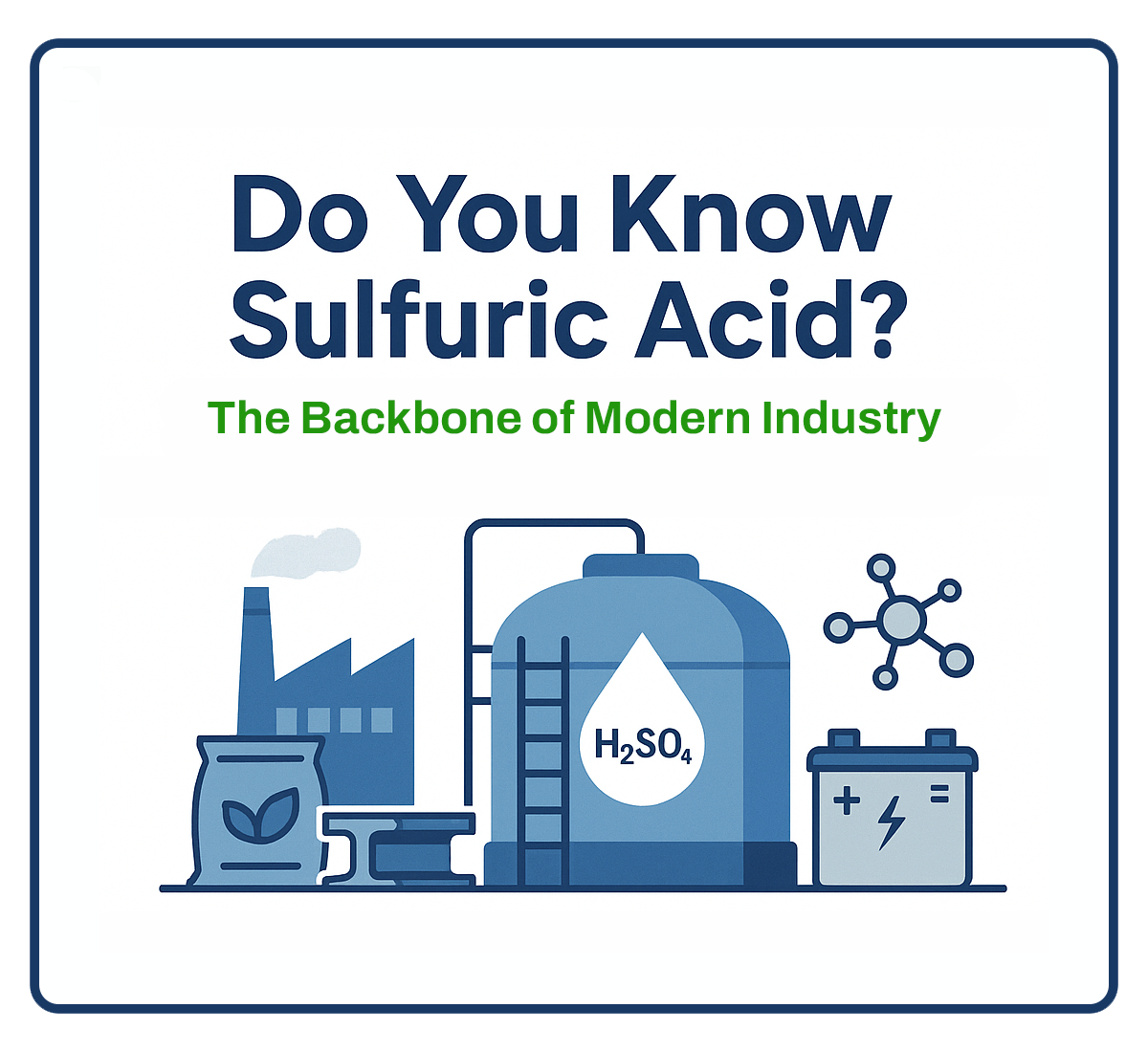
Sulfuric acid is the backbone of modern industry. Selecting the right supplier goes beyond price. Learn the five key factors—quality, compliance, logistics, support, and sustainability—that define a reliable partner. Discover how Brainerd Chemical delivers confidence, safety, and expertise in every supply relationship.

Sulfuric acid (H₂SO₄) is one of the most widely used and produced chemicals in the world—an indispensable foundation of modern manufacturing. From fertilizers that sustain global agriculture to batteries powering our vehicles and devices, sulfuric acid quietly drives progress across countless industries.

In fact, by volume, sulfuric acid is the largest industrial chemical produced in the United States, making its demand a trusted barometer of industrial activity and overall economic health.

Why Sulfuric Acid Matters

Sulfuric acid is a vital input in:

  • Fertilizers – supporting the production of phosphate fertilizers that feed the world.
  • Metals & Steel – essential in ore processing, pickling, and refining.
  • Energy Storage – powering lead-acid batteries used in vehicles, backup power, and renewable energy systems.
  • Chemicals & Materials – enabling the production of nylon, pigments, synthetic resins, detergents, and pharmaceuticals.

Without it, the world’s ability to grow food, build infrastructure, and develop new technologies would be significantly diminished.

Brainerd Chemical: Delivering Reliability & Stewardship

At Brainerd Chemical Company, we take pride in being a trusted partner to vendors and manufacturers who depend on sulfuric acid every day. Our commitment extends beyond supply—it’s about quality, safety, and stewardship.

  • Versatile Supply: We safely deliver bulk, packaged, blended, and cut sulfuric acid in concentrations from 1–93%.
  • Food-Contact Certification: Sub-80% concentrations are GFSI certified, enabling use in food contact applications.
  • Trusted Reliability: Our nationwide distribution network ensures steady supply, even in volatile market conditions.
  • Safety First: Every step of our process—from production to delivery—is built on rigorous safety standards and environmental responsibility.

A Strong Sulfuric Acid Industry = A Strong America

A robust sulfuric acid industry strengthens U.S. manufacturing, innovation, and economic independence. As COO Neil Morgan notes:

“By volume, sulfuric acid is the largest industrial chemical produced in the United States, making its demand a barometer of industrial activity and overall economic health.”

By supplying high-quality sulfuric acid, Brainerd Chemical helps reinforce America’s ability to compete globally, grow sustainably, and innovate boldly.

Selecting Your Ideal Sulfuric Acid Partner

Choosing a sulfuric acid supplier is about far more than comparing prices. The right partner provides a foundation of quality, safety, compliance, and reliability that supports both day-to-day operations and long-term growth.

When evaluating suppliers, companies should consider:

Product Quality & Consistency – Does the supplier meet stringent purity, concentration, and performance standards?

Regulatory Compliance – Can they provide the certifications, documentation, and support needed for strict industry and government requirements?

Logistics & Delivery – Is there infrastructure in place for on-time, safe, and flexible delivery across regions and scales?

Technical Support – Does the supplier provide expert guidance for handling, formulation, and process optimization?

Sustainability & Stewardship – Are environmental responsibility and safe practices at the core of operations?

Confidence at Every Step

At Brainerd Chemical Company, we deliver on every front—backed by infrastructure, expertise, and integrity that industry leaders rely on:

  • Safe, reliable supply from 1–93% concentrations
  • GFSI-certified sulfuric acid (<80%) for food contact use
  • Nationwide distribution with proven logistics capabilities
  • Dedicated technical specialists for regulatory and operational support
  • A commitment to safety, sustainability, and stewardship

Whether you need bulk supply, customized formulations, or regulatory guidance, Brainerd Chemical is your partner in growth and reliability.

To speak with a technical specialist about sulfuric acid sourcing, compliance, or custom solutions, contact us at +1 (918) 622-1214.

About Brainerd Chemical Company

Brainerd Chemical Company is a leading U.S. manufacturer and distributor of specialty and commodity chemicals, proudly serving critical industries including energy, agriculture, water treatment, and manufacturing. Our mission is simple yet powerful: to safely supply the solutions our customers need, the expertise they want, and the reliability they depend on—every single day.

Media Inquiries

Brainerd Chemical Company

📞 +1 (918) 622-1214

🌐 www.BrainerdChemical.com

Nitric Acid Suppliers Aren’t Created Equal

Brainerd Chemical Company supplies a full range of nitric acid products — including Diluted and Custom blends tailored to your needs.

What makes Brainerd different is our focus on stewardship. Brainerd is privately held, flexible, and built for performance.

✅ Custom packaging + blending to your spec

✅ Multiple distribution hubs = shorter lead times

✅ Hands-on technical support beyond the sales desk

✅ Proven record of safe hazardous chemical handling

Whether you need high-purity nitric for manufacturing or industrial-grade volumes for large-scale operations, Brainerd Chemical brings value beyond the barrel.

About Brainerd Chemical Company

Brainerd Chemical Companies mission to safely supply our customers with the hazardous chemical solutions they need, the support they want, and the reliability they depend on to meet the challenges they face every day.

Media Inquiries:

Brainerd Chemical Company:  1+ (918) 622-1214

SOURCE: Brainerd Chemical Company.